
Web Development
How We Built Digital Dehari: A Verified Worker Marketplace Like TaskRabbit (Case Study)
Inside Digital Dehari: how Viltora built a TaskRabbit-style marketplace for verified plumbers, electricians and karigars, with ID checks, 0% commission, keypad-phone access and 1,200+ SEO pages.
Short answer: Digital Dehari is a TaskRabbit-style marketplace for hiring daily-wage workers and skilled karigars — plumbers, electricians, carpenters, masons, painters, AC technicians and more. Viltora built it as an Urdu-first platform where every worker is identity-checked before they get a Verified badge, workers keep 100% of their wage, and even people with a basic keypad phone and no internet can join. On top of the product we built a search engine growth system: more than 1,200 pages in the sitemap covering 100+ cities and 11 trades, so people find the platform the moment they search "hire a plumber in Lahore" or "TaskRabbit alternative".
This post walks through what we built, the decisions behind it, and what any founder planning an "app like TaskRabbit", Thumbtack or Angi can take from it. You can see the live platform at digitaldehari.com.
The client and the problem
In Pakistan, most daily-wage hiring still happens at the chowk — a street corner where workers wait from early morning, hoping someone pulls up with a job. It works, but it is broken for both sides:
- Hirers can't check who they're hiring. There is no ID, no rating, no record of past work. You hire a stranger and hope.
- Workers can't be found. A skilled electrician is invisible to anyone who doesn't drive past his corner that morning.
- Middlemen take a cut. Thekedars and agents often keep part of the wage the hirer pays.
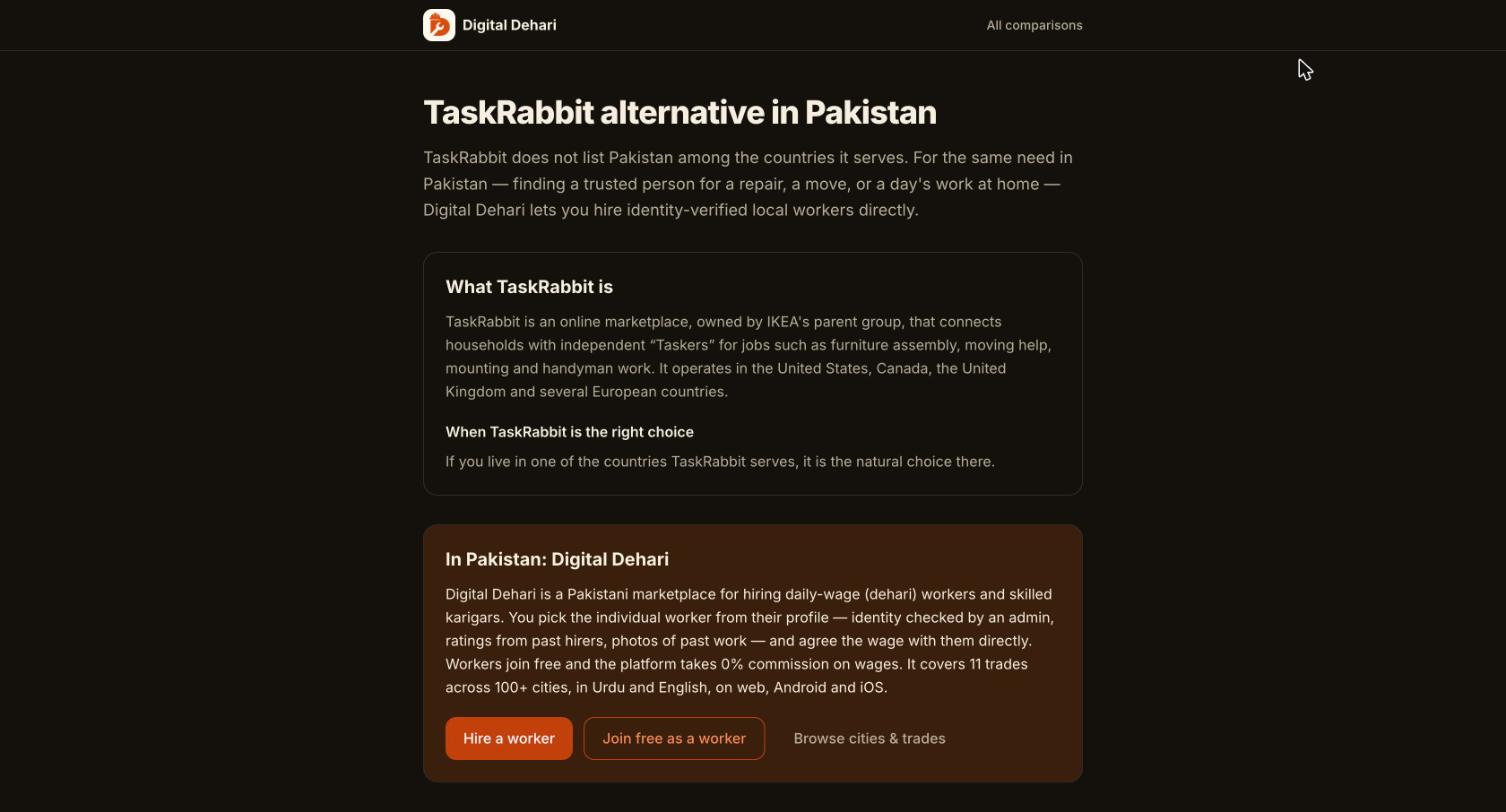
- The global apps don't serve this market. TaskRabbit, for example, doesn't list Pakistan among the countries it serves.
Trust is not just a Pakistani problem. In the US, about 1 in 10 Americans have been victims of a contractor scam, losing an average of $2,426, according to a JW Surety Bonds study reported by the National Association of Realtors. Every home-services marketplace, in any country, lives or dies on one question: can I trust the person who shows up at my door?
Digital Dehari's brief was to answer that question for Pakistan's daily-wage economy — and make the platform easy to find on Google from day one.
What we built
| Area | What's on the platform |
|---|---|
| Hiring | Search workers by city, area and skill, in a list view or a map view, with 11 trades: carpenter, plumber, electrician, mason, painter, helper, driver, gardener, cleaner, AC technician and welder |
| Trust | ID verification reviewed by an admin before a Verified badge appears, ratings from real hirers, photos of past work, in-app reporting with admin review within 24 hours |
| Fair pay | Free for workers, 0% commission on wages — the worker keeps the full wage agreed with the hirer |
| Access | Web, Android and iOS, plus registration from any keypad phone through the *7767# USSD menu, and SMS and automated voice calls |
| Language | Urdu and English, with an instant helper that understands English, Urdu and Roman Urdu |
| Hirer tools | Requests, orders, favourites, messages, a jobs board, a marketplace, notifications, and a verification badge for hirers too |
| Free tools | A calculator and an invoice generator for workers and small contractors |
| Growth | 1,200+ indexable pages: city pages, city × trade pages, 15 guides and 11 comparison pages |
Designing for trust
A marketplace for strangers entering your home has to earn trust on every screen. We built trust into the product, not just the marketing copy.
Verified means verified. A worker submits their CNIC (Pakistan's national ID), and the Verified badge only appears after the Digital Dehari team has reviewed the document. There is no paid shortcut to the badge.
You choose the worker. Unlike platforms that auto-assign whoever is free, Digital Dehari shows hirers each worker's profile, ratings and photos of past work, so the hirer picks the person — just like choosing someone at the chowk, but with far more information.
Hirers get verified too. Trust runs both ways. Hirers see a "Get verified" prompt, because a verified badge helps workers trust them and reply faster.
Problems get handled fast. In-app reporting goes to an admin review within 24 hours, so a bad actor can't quietly keep working on the platform.
No commission on wages. Workers join free and keep 100% of what they agree with the hirer. That one decision removes the biggest reason workers avoid platforms — and the biggest reason they'd try to take jobs off-platform.
Built for people without smartphones
This was the most important product decision we made, and the one most marketplace apps get wrong.
Many daily-wage workers in Pakistan use basic feature phones, often without a regular mobile data package. An app-only marketplace would shut out the very people it's meant to serve. So Digital Dehari works on any phone:
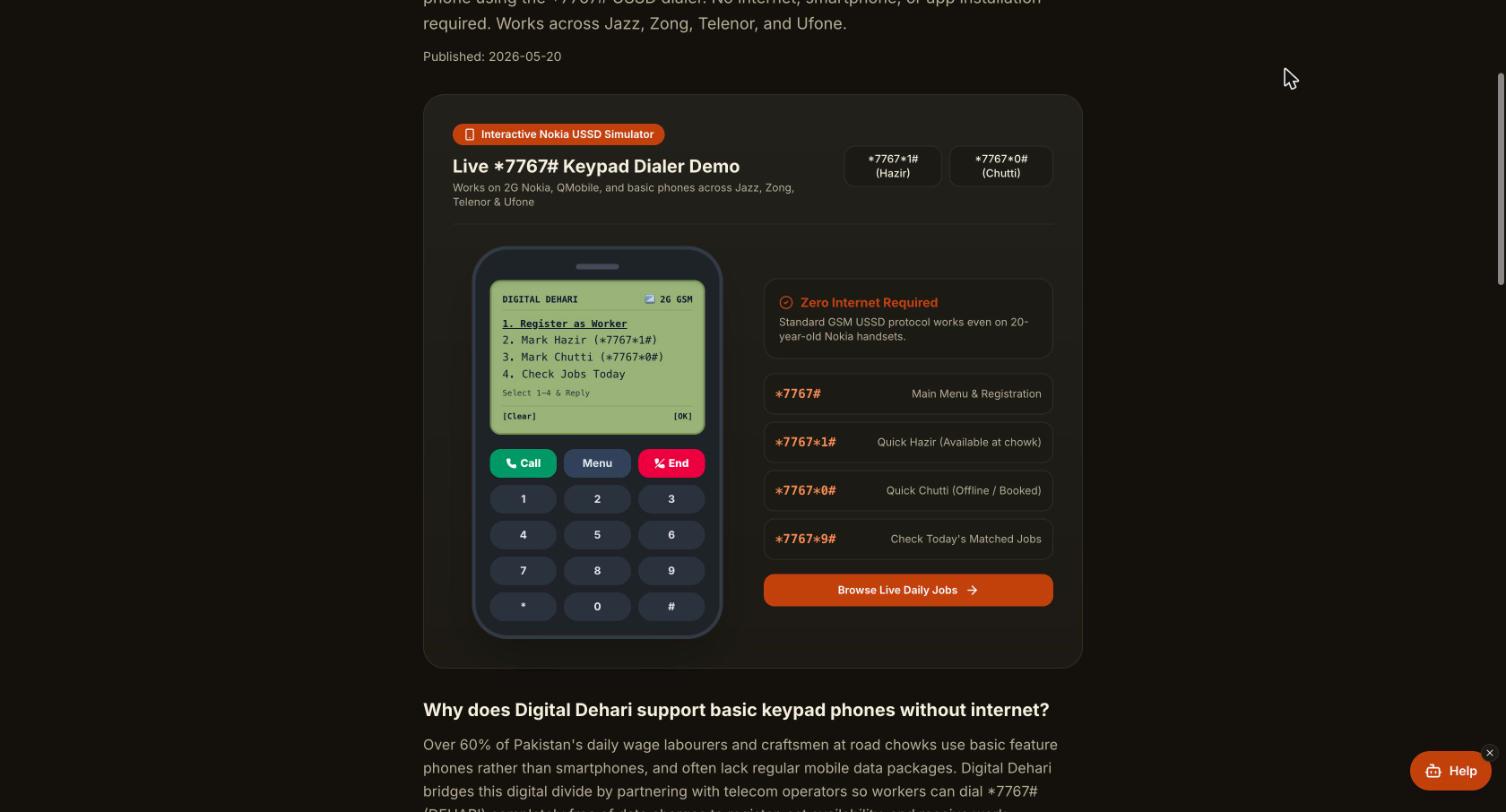
- *7767# USSD menu — dial a short code on any 2G keypad phone to register as a worker, check today's matched jobs, or mark yourself available.
- One-dial status updates — *7767*1# marks a worker Hazir (available) and *7767*0# marks them Chutti (offline or booked). No typing, no app, no internet.
- Works on every major network — Jazz, Zong, Telenor and Ufone.
- SMS and automated voice calls — job alerts reach workers who never open an app.
The lesson for any founder: design for your hardest-to-reach user first. If your supply side can't use your product, your demand side will find an empty marketplace.
Urdu-first, not "translated later"
Most apps in emerging markets launch in English and bolt on a local language later. Digital Dehari is Urdu-first, with English alongside it.
The best example is the instant helper on the homepage. A hirer who doesn't know which tradesperson they need can just describe the problem — "tap is leaking", "fan not working", "shifting house tomorrow", "AC not cooling" — in English, Urdu or Roman Urdu, and the platform tells them which kind of worker to hire. It removes the most common reason people give up: not knowing what to search for.
One platform, four kinds of user
A home-services marketplace is never just "buyers and sellers". We mapped four distinct roles and gave each its own flow and its own guide:
- Karigars and workers — register (even by keypad phone), list skills, get verified, mark availability and receive jobs.
- Hirers and households — find, compare and hire workers, track requests and orders, save favourites and message workers.
- Thekedars and agents — the contractors who already organise teams of workers, brought onto the platform instead of being cut out.
- Organisations and enterprises — businesses that need several workers or recurring labour.
Bringing thekedars on board was a deliberate choice. They already control a large share of labour supply. Making the platform useful to them grows supply far faster than fighting them.
The SEO engine: 1,200+ pages that rank for real searches
A marketplace with no traffic is a ghost town. So from day one we treated search as part of the product, the same approach we took on our Accountant For All website.
People don't search "labour marketplace". They search "plumber in Lahore", "electrician Karachi" or "AC technician Islamabad". So we built pages for exactly those searches:
- City hubs — 100 city pages, from Lahore, Karachi and Bahawalpur to Dubai, London, Toronto, Riyadh and 10 US cities including New York, Houston, Chicago and Los Angeles, across 13 countries.
- City × trade pages — a dedicated page for each trade in each city, such as "hire a plumber in Lahore" or "hire an electrician in Karachi".
- Guides — 15 guides for every audience, such as how to hire a CNIC-verified karigar, chowk vs online hiring, daily-wage jobs in Pakistan, and the difference between a mistri, ustad and thekedar.
- Comparison pages — 11 pages that meet people searching for alternatives, such as "TaskRabbit alternative in Pakistan", "Instawork alternative" and comparisons with local competitors.
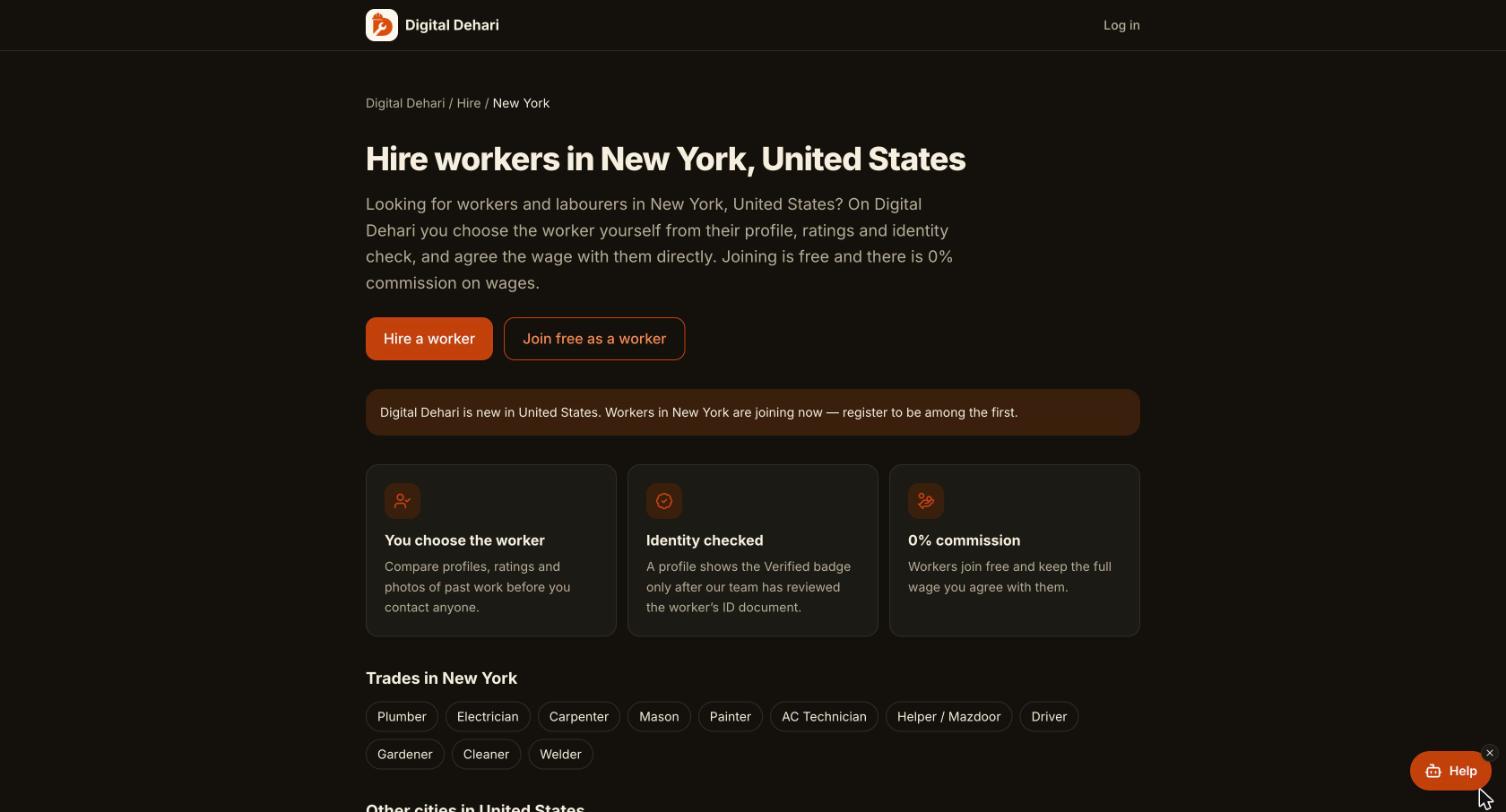
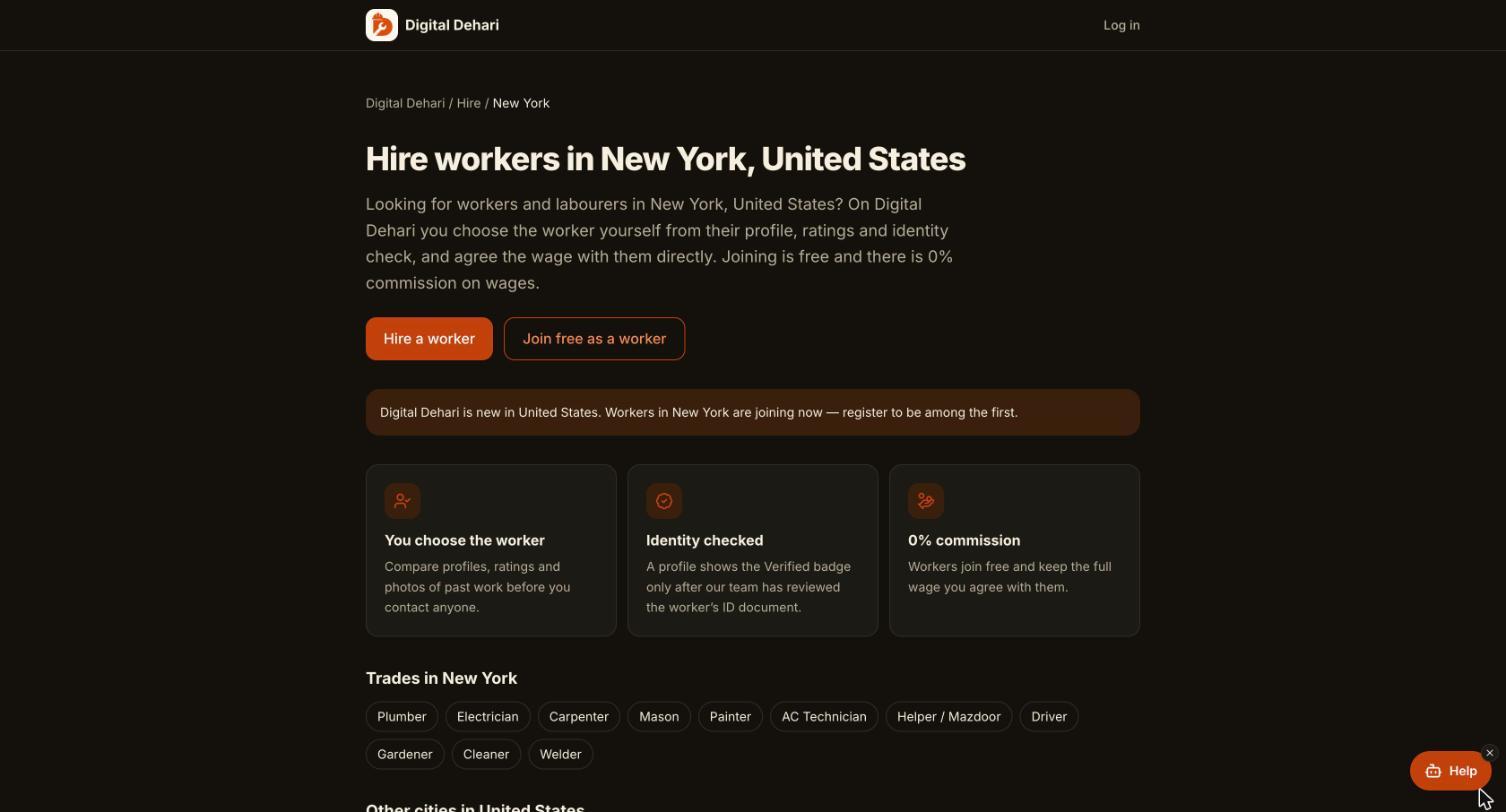
Every one of those pages is honest about where the platform is. The US city pages, for example, say plainly that Digital Dehari is new in the United States and workers are joining now. That honesty matters: thin pages that promise what isn't there get ignored by Google and abandoned by visitors.
On the technical side, every page gets:
- A unique title and meta description written for the page's main search.
- Structured data (Schema.org) — Organization, FAQPage, Article and AboutPage markup, so Google can show richer results and answer questions directly.
- An XML sitemap with 1,247 URLs, each with a sensible update frequency: the jobs board is marked hourly, city pages weekly, legal pages yearly.
- Fast server rendering with Next.js, so search engines and slow mobile connections both get real content immediately.
The tech behind it
Digital Dehari runs on Next.js, which gives us server-rendered pages for SEO and a fast, app-like experience for logged-in users in the same codebase. It's installable as a progressive web app, and it's also available on Android and iOS, while the USSD, SMS and voice channels cover users who have no smartphone at all.
The logged-in dashboard is built for speed on cheap phones: a single "Find Workers" screen with city, area and skill filters, one-tap trade chips, a list and map toggle, a global search, and a profile-completion meter that nudges users toward verification.
Results so far
The platform launched with more than 1,200 pages in its sitemap and describes itself as open in 105 cities. Instead of one homepage competing for every search, Digital Dehari now has a focused page for each city, each trade in each city, each common question and each competitor people compare it with — and a clear path from every one of those pages to "Hire a worker" or "Join free as a worker".
What founders building an app like TaskRabbit can learn
If you're planning a home-services or gig marketplace — in the US, the UK, Canada, the Gulf or anywhere else — these are the lessons that transfer:
- Trust is the product. Real ID checks, real ratings and fast handling of reports matter more than any feature.
- Design for your hardest-to-reach supplier. If workers can't join easily, hirers will find an empty marketplace.
- Remove the reason to go off-platform. Charging workers 0% commission takes away their reason to take jobs off-platform.
- Build the SEO engine with the product. City and trade pages, guides and comparison pages bring in buyers at the exact moment they need help.
- Bring existing middlemen inside. Thekedars, agencies and contractors can be your fastest supply channel.
- Speak your users' language. Not just translation — understand how people actually describe their problem.
Frequently asked questions
How much does it cost to build an app like TaskRabbit? It depends on the number of user roles, the platforms (web, iOS, Android), and features like verification, payments and messaging. We break down typical budgets in our app development cost guide for 2026 and our website development cost guide.
Which tech stack is best for a marketplace app? For Digital Dehari we used Next.js for the web platform and SEO pages. For startups that also need native apps quickly, see our guide to React Native and Expo.
Do marketplace apps really need SEO? Yes. Paid ads get expensive fast in two-sided marketplaces, because you pay to acquire both buyers and sellers. Pages built around real searches — "plumber in [city]" — keep bringing in users without paying for every click.
Can Viltora build a marketplace like this for the US, UK or Canada? Yes. The same building blocks — verification, two-sided profiles, city and trade pages, messaging and job boards — work for any local services market.
Want a marketplace like this?
Viltora designs and builds fast, SEO-first websites and apps for startups and service businesses in the US, UK and Canada, with fixed USD quotes and full ownership of everything we build. See Digital Dehari live, read our Accountant For All case study, explore our app development services, or get a free quote.
- #marketplace app
- #TaskRabbit alternative
- #Next.js
- #SEO
- #case study
Founder & CEO, Viltora
Zulfqar Ali founded Viltora and leads every game, mobile app, website and AI project the studio ships for startups in the US, UK and Canada.
Related Articles

Web Development
How We Built an SEO-First Website for a US Accounting Firm (Accountant For All)
Inside the Accountant For All website: how we planned, designed and built an SEO-first site for a US bookkeeping and CFO firm — page structure, case studies, lead capture and technical SEO.
Zulfqar Ali 5 min read
- accounting firm website
- CPA website design
- bookkeeping website
Web Development
How Much Does a Website Cost in 2026? (USD Price Guide for Businesses)
What a business website, online store or web app really costs in 2026 — USD ranges, US agency vs offshore pricing and the hidden yearly costs.
Zulfqar Ali 2 min read
- website development cost
- how much does a website cost
- website cost 2026
App Development
How Much Does It Cost to Build an App in 2026? (USD Price Guide)
Real 2026 app development costs in USD — simple, mid-size and complex apps, US agency vs offshore rates, and what drives the price up or down.
Zulfqar Ali 3 min read
- app development cost
- how much does an app cost
- mobile app cost 2026


Let's Build Something Great Together
Tell us about your project, goals or challenges — our team will connect with you and explore the right solution.
Let's Get Started