
AI
AI Agents for Small Business in 2026
Big firms are scaling AI agents while small businesses stall. Here’s what the 2026 data shows, what UK rules expect, and how to build an assistant that works.
AI Agents for Small Business in 2026: Why Most Firms Are Stuck, and How to Build One That Works
Nov 15, 2026 · @Viltora
Everyone says you need an AI agent. Few say why so many give up on them.
Scroll through any business feed this year and you'll be told a small company without an AI agent is already behind. What you won't see is how many owners tried one, got a few odd answers, and quietly switched it off.
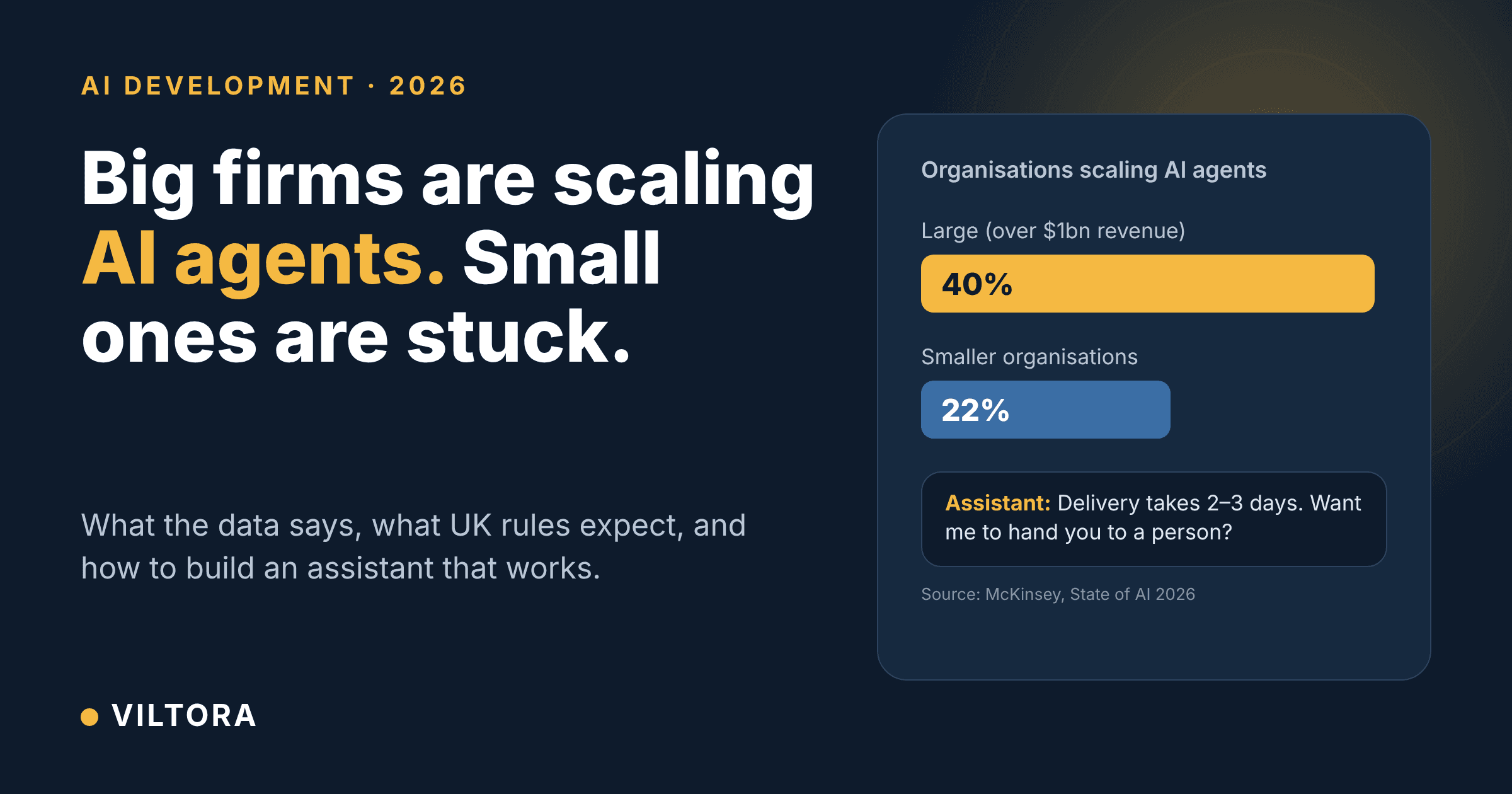
McKinsey's State of AI 2026 report, published in August, gives the gap some numbers. Among large organisations (over $1 billion in revenue), 40% say they are scaling AI agents, up from 27% a year earlier. Among smaller ones, the figure hasn't moved. It sits at 22%.
The wider picture is humbling too. Only 37% of the people surveyed said AI had made any difference to their company's profit, which is the same as the year before. About one in five said the running costs of AI, tokens included, had held them back.
None of that means small businesses are slow. Plenty have tried a chatbot or used ChatGPT for emails. But trying a tool and changing how a business runs are two different things, and the second one is where most projects stall. Below we cover why that happens, what UK businesses need to watch this year, and how we'd go about building an assistant that actually earns its place.
Why small projects stall
The reasons are rarely technical. They tend to be boring, and that's good news, because boring problems can be fixed.
The job was never defined. "We want an AI agent" is a wish, not a brief. The projects that go well start with one irritating task, such as answering the same twenty customer questions or sorting incoming enquiries, and a clear picture of what "done well" looks like.
The assistant knows nothing about the business. A general model can write a polite reply, but it can't tell a customer your delivery times, your refund rules or what you charge for a rush job. Without your own documents behind it, it guesses. Customers notice.
Nobody measures it. Teams launch, glance at a few chats, and decide it feels okay. A month later someone finds it has been giving out the wrong opening hours. If you can't say how often it gets things right, you can't improve it.
The running costs creep up. That one-in-five figure from McKinsey is real. A chatty assistant on a large model, with long prompts and no limits, can cost far more than anyone planned for.
There's no plan for when it's wrong. Every assistant gets things wrong sometimes. The question is whether a person can step in quickly, and whether the customer ever knows one was needed.
Chatbot or agent? Pick the smaller one first
The two words get used as if they mean the same thing. They don't.
A chatbot answers questions. A customer asks what your returns policy is, and it finds the right answer in your documents and replies. It reads, and it talks. That's all.
An agent goes a step further and does things. It might book the appointment, update the order in your system, draft the quote and send it for approval, or chase an unpaid invoice. It can use your tools, which is exactly why it needs more care.
For most small businesses, we'd start with a chatbot grounded in your own information. It's quicker to build, easier to test and much cheaper to run. Once it's answering well and you trust it, give it one small action, such as creating an enquiry in your CRM. Then another. Each step is easy to check, and if something breaks you know where to look.
Going straight to a fully independent agent is how a lot of projects end up as a demo that never quite goes live. Small steps are less exciting. They also work.
What UK businesses need to keep in mind
If you serve customers in the UK, the Data (Use and Access) Act 2025 is worth ten minutes of your time. Parts of it came into force in February 2026, and they cover decisions made by automated systems.
As we read the FSB's legal hub summary, the rules are more flexible than the older ones. They don't ban tools like onboarding checks or credit checks. They do expect you to:
- tell people when a significant decision about them was made automatically
- let them respond to it or challenge it
- offer a human review if they ask for one
Since 19 June 2026 there has also been a duty to have a clear, recorded way for people to raise data protection complaints.
In practice, an assistant that answers opening-hours questions is a very different thing from one that decides who gets a refund or a credit limit. The more it affects someone's money or access to a service, the more you want a person in the loop and a record of what happened. That's easy to design in from day one and painful to bolt on later.
In the US, there's no single federal AI law for businesses to follow. Rules vary by state and by industry, so check what applies where your customers are. This post is general information, not legal advice. For anything high-stakes, ask a solicitor or attorney, and read the Act and the ICO's guidance yourself.
A simple way to start
If we were starting from scratch with a small business, this is the order we'd work in.
-
Pick one job.
Choose a task that's repetitive, has clear right answers and costs your team real time. Write down what a good result looks like.
-
Give it your own material.
Feed the assistant your FAQs, price lists, policies and past replies, so it answers from what's true for your business instead of guessing.
-
Test before every release.
Build a list of real questions with known answers, run them each time you change something, and track how often it gets them right. If the score drops, you hold the release.
-
Keep a person close.
Make it easy to hand a chat to a human, log what the assistant did, and set limits on cost and on what it's allowed to do.
That's it. Nothing clever, and it's the part most projects skip.
Want a hand with it?
This is the kind of work we do at Viltora. We build AI chatbots, assistants and automations grounded in your own data, test them before each release, and stay on after launch to fix and improve. You'll talk directly to the people building it, with weekly updates and clear pricing.
If you have a task in mind, tell us about it at hello@viltora.org or through our contact page. We usually reply within 24 hours.
Sources
(25 August 2026)
- #ai agents
- #ai chatbot
- #custom ai assistant
- #small business ai
- #ai automation
- #rag chatbot
- #ai development
- #uk business
- #usa business
- #viltora
Related Articles
Game Development
Why Low Poly Games Are a Smart Choice for Indie Studios
Low poly art keeps games fast, affordable and beautiful. Here is how we plan, model and optimise low poly games in Unity for mobile and PC.
Viltora Team 1 min read
- Unity
- Low Poly
- Mobile Games
App Development
React Native and Expo: The Fastest Way for Startups to Ship iOS and Android Apps
One codebase, two app stores. Why we build startup apps with React Native and Expo, and what you get from over-the-air updates and EAS Build.
Viltora Team 1 min read
- React Native
- Expo
- iOS
Infrastructure
Vercel, Railway, AWS or Hostinger? Choosing the Right Host for Your Project
A plain-English comparison of Vercel, Railway, AWS and Hostinger — and how we decide where to deploy each website, app backend and API.
Viltora Team 1 min read
- Vercel
- AWS
- Railway


